
Train travel across Europe tips can make the difference between a stressful multi city trip and a smooth, memorable journey. Europe has an extensive rail network connecting major capitals, historic cities, mountain towns, coastal destinations, and smaller communities, making trains one of the most practical ways to explore the continent.
Unlike flying, train travel often takes you directly from city center to city center. You can watch the landscape change outside your window, get up and stretch during longer journeys, avoid many airport procedures, and arrive ready to explore rather than exhausted from the airport experience.
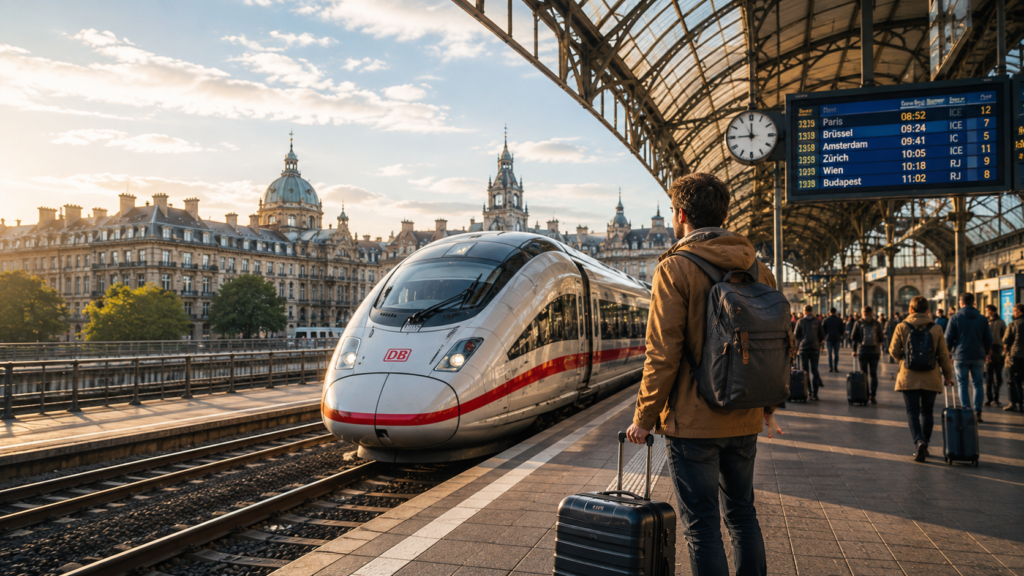
But traveling across Europe by train is not as simple as buying one ticket and boarding every train you see. Different countries use different railway companies, some high speed services require reservations, night trains work differently, and a cheap looking itinerary can become expensive if connections are poorly planned.
This guide explains the most useful train travel across Europe tips, from choosing your route and booking tickets to handling luggage, connections, train passes, overnight journeys, and unexpected delays.
Why Train Travel Across Europe Is Worth Considering
Europe is particularly well suited to rail travel because many major destinations are connected by frequent domestic and international services.
A journey such as Paris to Brussels, Amsterdam to Paris, Vienna to Budapest, or Munich to Salzburg can be part of a larger itinerary without requiring another airport transfer.
High speed trains can also make rail competitive with flying when you consider the entire journey rather than simply the time spent in the air. For example, Eurostar currently connects major destinations across France, Belgium, the Netherlands, Germany and the UK, with London Paris services taking about 2 hours 16 minutes.
Another advantage is the experience itself. Instead of seeing Europe as a collection of airports and hotels, traveling by train allows destinations to feel connected. The journey becomes part of the holiday.
For travelers who prefer slower, more immersive trips, this can be one of the biggest advantages of exploring Europe by rail.
Plan Your European Train Route Before Booking
One of the most important train travel across Europe tips is to plan the route before buying tickets.
It is tempting to look at a map and add every city that sounds interesting. However, too many stops can turn a relaxing holiday into a constant cycle of packing, checking out, finding stations, and catching trains.
A better approach is to group destinations geographically.
For example, you could create a route such as:
Paris → Brussels → Amsterdam → Berlin → Prague → Vienna → Budapest
This generally makes more sense than repeatedly crossing the continent.
Give Yourself Enough Time in Each City
A train journey may take only a few hours, but changing cities still consumes part of your day.
Remember to account for:
- Getting to the station
- Finding the correct platform
- Boarding time
- Delays
- Hotel check in
- Local transportation
- Time needed to settle into a new destination
If you are visiting a city for the first time, staying at least two or three nights can often provide a better experience than moving every day.
Avoid Overloading Your Itinerary
A common mistake is trying to visit ten European cities in two weeks.
You may technically be able to do it, but you will spend a surprising amount of time in transit.
A slower itinerary allows you to explore neighborhoods, visit local restaurants, take spontaneous walks, and experience destinations beyond their most famous attractions.
Understand the Different Types of European Trains
European trains are not all the same. Understanding the difference helps you choose the right service for your journey.
High Speed Trains
High speed trains are ideal when you want to travel between major cities quickly.
They are especially useful on popular international routes and long domestic journeys.
Examples include services such as Eurostar and other national high speed networks.
They are usually comfortable, but popular departures can require advance reservations and may become more expensive as travel dates approach.
Regional and Intercity Trains
Regional trains are generally slower but can be extremely useful for shorter journeys and smaller destinations.
They often provide more flexibility because you are not always paying for a premium high speed service.
For scenic travel, regional trains can sometimes be more enjoyable because you have more time to appreciate the countryside.
Night Trains
Night trains are particularly useful for long distances.
Instead of losing most of a daytime sightseeing period to transportation, you can travel while sleeping and wake up in another destination.
Night train availability varies by route and season, so always check the current timetable before building your itinerary.
As of 2026, European Sleeper operates overnight routes including Paris Berlin, Brussels Prague and Brussels Milan.
Train Pass or Individual Tickets?
This is one of the biggest decisions when planning a European rail trip.
A rail pass can be convenient if you are taking many trains across several countries. Individual tickets can be better when your itinerary contains only a handful of journeys.
The important point is that a rail pass does not necessarily mean every train is completely reservation free.
Some high speed and international trains may require an additional seat reservation.
Before purchasing a pass, compare:
- Number of journeys
- Individual ticket prices
- Reservation fees
- Pass validity
- Flexibility requirements
- First or second class preferences
- Whether your selected routes are included
For a simple three or four city trip, individual tickets may be easier.
For a longer trip involving frequent train journeys, a rail pass may offer greater flexibility.
Book European Trains at the Right Time
Booking strategy can significantly affect the price of your trip.
For popular high speed routes, it is generally wise to compare prices as soon as your travel dates become available.
However, don’t automatically buy the first ticket you find.
Compare the official railway operator with reputable rail booking platforms and check exactly what the fare includes.
Look carefully at:
- Refundability
- Changes
- Seat reservations
- Class of travel
- Luggage rules
- Connection protection
- Boarding requirements
A very cheap ticket may have strict conditions, while a slightly more expensive fare can offer much more flexibility.
Understand Train Reservations
One of the most important train travel across Europe tips is to check whether your particular train requires a reservation.
Some regional trains allow you to simply board with a valid ticket. Others, especially certain high speed and international services, use mandatory reservations.
This matters particularly if you are traveling with a rail pass.
You may have a valid pass but still need a reservation before boarding.
Always check the specific train rather than assuming that your pass covers everything automatically.
Leave Enough Time Between Connecting Trains
Connections deserve more attention than they usually receive.
A journey might look perfect on a booking website with only 10 minutes between trains. But a short connection can become stressful if your first train arrives late or you need to change platforms.
For important international connections, allowing additional time is often worth it.
Be especially careful when:
- Changing stations within a city
- Traveling with children
- Carrying large luggage
- Crossing international borders
- Using separate tickets
- Connecting to a night train
- Catching your final train of the day
If you have separate tickets, don’t assume that the second operator is automatically responsible if the first train is delayed.
The European Commission has noted that journeys involving multiple tickets and operators can currently provide more complicated passenger protection than a single through ticket. New EU proposals announced in 2026 aim to simplify multi-operator booking and strengthen protection across an entire journey.
Choose Central Stations When Possible
One underrated advantage of European train travel is that many major stations are located close to city centers.
This can save significant time compared with airports located far outside cities.
When comparing two train options, don’t look only at the journey duration.
Also consider:
Where does the train arrive?
A train that takes 30 minutes longer but arrives in a central station may actually be more convenient than a faster service requiring a long transfer from an outlying station.
Before booking accommodation, check which station you will use.
Major cities can have several railway stations, and choosing a hotel near the wrong one can make departure day unnecessarily complicated.
Pack Light for a European Rail Trip
One of the best practical train travel across Europe tips is to pack less.
You may need to lift your luggage onto the train, carry it through stations, store it near your seat, and move it between platforms.
A large suitcase can become especially inconvenient during a trip involving multiple connections.
A compact suitcase or travel backpack is usually easier to manage.
Pack essentials such as:
- Comfortable walking shoes
- Lightweight clothing
- Weather appropriate layers
- Universal travel adapter
- Phone charger
- Power bank
- Reusable water bottle
- Small day bag
- Travel documents
- Basic toiletries
Keep important documents and valuables in your personal bag rather than buried inside your main luggage.
Know the Difference Between Station Time and Airport Time
Train stations generally involve fewer procedures than airports, but you should still arrive early enough to locate your train and platform.
Do not assume that every European train station operates exactly the same way.
Large stations can be confusing, particularly during busy periods.
Your train may not appear on the departure board until relatively close to departure, and platform information can sometimes change.
Check:
- Train number
- Destination
- Departure time
- Platform
- Carriage number
- Seat number
If your ticket specifies a coach and seat, find them before settling down.
Download Important Travel Information Before Leaving
Internet access is useful, but you should not depend entirely on mobile data.
Save important information offline, including:
- Train tickets
- Booking confirmations
- Hotel addresses
- Train numbers
- Departure times
- Reservation details
- Important railway apps
- Maps of destinations
Screenshots can also be useful when entering stations with unreliable connectivity.
For major journeys, keep a simple written record of your itinerary as a backup.
Use Train Apps and Railway Websites
Official railway websites are valuable for checking schedules, disruptions and ticket conditions.
This is particularly important close to departure.
For example, European Sleeper advises passengers to check national railway planners for the most up-to-date information on the day of departure because engineering works and other changes may not always appear in standard timetables.
That is a useful lesson for European rail travel generally:
Check your train shortly before departure, even if you booked it weeks ago.
Take Advantage of Scenic Train Journeys
Not every train journey needs to be chosen purely for speed.
Some European routes are attractions in themselves.
Mountain landscapes, lakes, forests, vineyards and countryside can transform an ordinary transfer into one of the memorable parts of your trip.
If scenery matters to you, research the route before booking.
Sometimes a slower daytime train is worth choosing instead of a faster service simply because the landscape is more interesting.
Consider Traveling by Night
Night trains can save both time and potentially a hotel night.
Instead of checking into a hotel in one city, sleeping, checking out and spending the following day traveling, you can cover the distance overnight.
European Sleeper’s current network provides examples of how night trains can connect cities such as Paris, Berlin, Brussels, Prague and Milan.
However, night trains are not ideal for everyone.
Pros of Night Trains
- Save daytime travel time
- Potentially save on accommodation
- Wake up in another destination
- Enjoy a distinctive travel experience
- Useful for long distances
Cons of Night Trains
- Sleep quality may vary
- Private compartments can cost more
- Availability is limited on some routes
- Timetables may change
- A poor night’s sleep can affect the following day
If sleep is important to you, compare the cost of a private compartment with the price of a normal hotel room.
What to Expect at European Train Stations
Large European stations can feel like small transportation cities.
You may find:
- Cafés
- Restaurants
- Shops
- Toilets
- Lockers
- Information desks
- Ticket offices
- Multiple platforms
- Underground or connecting passages
Arriving at a major station for the first time can be overwhelming.
Look for the departure board first.
Then identify your train number and platform.
Don’t simply follow the destination name because several trains may serve the same city at different times.
Keep an Eye on Your Belongings
European train travel is generally convenient, but crowded stations and trains require normal travel awareness.
Keep valuables secure and avoid leaving passports, wallets, phones or cameras unattended.
When luggage is stored away from your seat, make sure you know where it is and check it before leaving the train.
The goal isn’t to travel anxiously; it’s simply to maintain the same awareness you would use in any busy international destination.
Understand Delays and Passenger Rights
Train delays happen, especially on complex international networks.
The good news is that passengers traveling on rail services covered by EU rules have defined rights regarding delays, cancellations, missed connections and other problems.
EU rail passenger rules generally apply to rail journeys within the EU, although specific exemptions can apply to certain services.
If something goes wrong:
- Keep your ticket and reservation.
- Check the operator’s official information.
- Ask railway staff for instructions.
- Keep receipts for reasonable expenses where relevant.
- Check whether you are eligible for compensation or reimbursement.
- Submit claims according to the operator’s procedure.
Don’t assume that every journey has identical rights. Your ticket type, route, operator and whether you booked separate tickets can matter.
Best Time for Train Travel Across Europe
There isn’t one perfect season for European rail travel.
Spring
Spring can be an excellent compromise between weather, crowds and sightseeing conditions.
Cities become lively again, while many destinations are less intense than during peak summer.
Summer
Summer offers long daylight hours and generally favorable conditions for sightseeing, but popular destinations can be crowded and expensive.
Book popular trains and accommodation early.
Autumn
Autumn can be particularly appealing for travelers who enjoy cooler weather and scenery.
It is also a good period for city focused itineraries.
Winter
Winter rail travel offers a completely different atmosphere.
Christmas markets, snowy landscapes and winter destinations can make train travel especially memorable.
However, winter weather can also create delays, so allow extra flexibility when planning important connections.
How Much Does Train Travel Across Europe Cost?
There is no single price for a European rail trip.
Your total cost depends on:
- Countries visited
- Distance traveled
- Train type
- Booking date
- Travel season
- Ticket flexibility
- Class
- Reservations
- Number of journeys
- Night trains
- Rail passes
Rather than setting a fixed daily rail budget, calculate your itinerary route by route.
Compare the total cost of individual tickets against the total cost of a rail pass, including reservations and other required fees.
This is more reliable than assuming a pass is automatically cheaper.
Common Mistakes to Avoid
Even experienced travelers can make avoidable rail mistakes.
One of the biggest is booking too many destinations.
Another is assuming that every train works the same way.
Other mistakes include:
- Not checking the departure station
- Booking extremely short connections
- Forgetting reservations
- Carrying oversized luggage
- Ignoring ticket restrictions
- Not checking timetable changes
- Confusing train numbers
- Booking separate tickets without enough connection time
- Arriving at the station without offline ticket information
A little preparation can eliminate most of these problems.
Is Train Travel Across Europe Worth It?
For most travelers planning a multi city European vacation, yes train travel is absolutely worth considering.
It works particularly well when your itinerary includes cities with strong rail connections. You can often travel directly between central stations while enjoying more space and freedom than you would typically have on a short haul flight.
It is not always the cheapest option, and flying can make more sense for certain long distance combinations. But when airport transfers, check in time, baggage restrictions and transportation from airports into cities are included, rail can become much more competitive.
The biggest benefit is flexibility. You aren’t simply getting from one destination to another—you are experiencing the geography between them.
Train Travel vs Flying Across Europe
| Factor | Train | Flying |
|---|---|---|
| City center access | Often excellent | Often requires airport transfer |
| Security procedures | Usually simpler | More extensive |
| Scenic views | Excellent | Limited |
| Short city to city trips | Often convenient | Can be inefficient |
| Long distance travel | Depends on route | Often faster |
| Luggage experience | Generally convenient | Airline dependent |
| Overnight options | Available on selected routes | Limited |
| Environmental impact | Often lower per passenger | Generally higher |
The best choice depends on the specific route rather than a blanket rule.
For short distances between well connected cities, trains are often particularly attractive.
For very long distances or poorly connected routes, flying may still be more practical.
A Simple Strategy for Planning Your European Rail Trip
Start with the cities you genuinely want to visit rather than beginning with train tickets.
Then put those cities into a logical geographical sequence.
After that:
Check train routes → compare journey times → compare ticket prices → check reservations → choose accommodation near convenient stations → build flexible connections.
Keep one or two flexible periods in your itinerary instead of scheduling every hour.
That way, a delayed train or unexpected opportunity doesn’t ruin the rest of your holiday.
Most importantly, don’t treat the railway timetable as the entire trip.
The purpose of train travel is to make exploring Europe easier—not to collect as many train journeys as possible.
FAQs About Train Travel Across Europe
Is train travel across Europe easy for first time visitors?
Yes. European rail networks can seem complicated initially, but once you understand train numbers, platforms, reservations and connections, they become relatively straightforward. Start with a simple itinerary involving well connected cities.
Do I need a rail pass to travel around Europe?
No. A rail pass is optional. Travelers taking only a few journeys may find individual tickets more convenient or less expensive, while frequent travelers may benefit from a pass.
Should I book European trains in advance?
For popular high speed and international routes, advance booking is often sensible. It can provide more choice and, depending on the fare system, potentially better prices.
Can I take luggage on European trains?
Yes, but luggage arrangements vary by train operator. Pack light enough that you can comfortably move your luggage through stations and store it without difficulty.
Are European train reservations necessary?
Not always. Some regional services don’t require reservations, while certain high speed, international and night trains may require or strongly recommend them. Always check the individual service.
How much connection time should I allow between European trains?
There is no universal minimum. For simple connections, a shorter transfer may work, but international journeys, large stations and separate tickets justify more time. When an important connection is involved, extra buffer time is usually worthwhile.
Are night trains worth taking in Europe?
They can be, particularly for long journeys. They allow you to travel overnight and potentially save daytime sightseeing time. However, compare the sleeping arrangement and cost with a regular hotel and daytime train.
What happens if my European train is delayed?
Depending on the journey and applicable rules, you may have rights to assistance, rerouting, reimbursement or compensation. Keep your ticket and check the operator’s procedures. EU passenger rights rules provide protections for many rail journeys, although exemptions and ticket arrangements can affect the exact rights available.
Conclusion
The best train travel across Europe tips are surprisingly simple: plan a logical route, don’t overload your itinerary, understand reservations, compare tickets with rail passes, pack light and leave enough time for connections. These small decisions can make an enormous difference to how relaxed your journey feels.
Train travel is particularly rewarding when you stop thinking of transportation as wasted time. A train window can become part of the experience, taking you from one European culture and landscape to another without the constant airport transfers associated with flying. From fast international services to scenic regional trains and overnight routes, rail gives travelers several ways to experience the continent.
If you’re planning a European adventure, train travel is worth considering for any itinerary built around well connected cities. Choose fewer destinations, give yourself room to explore, and treat the journey between cities as part of the trip. With a little preparation, traveling across Europe by train can be one of the easiest, most comfortable and memorable ways to see the continent.