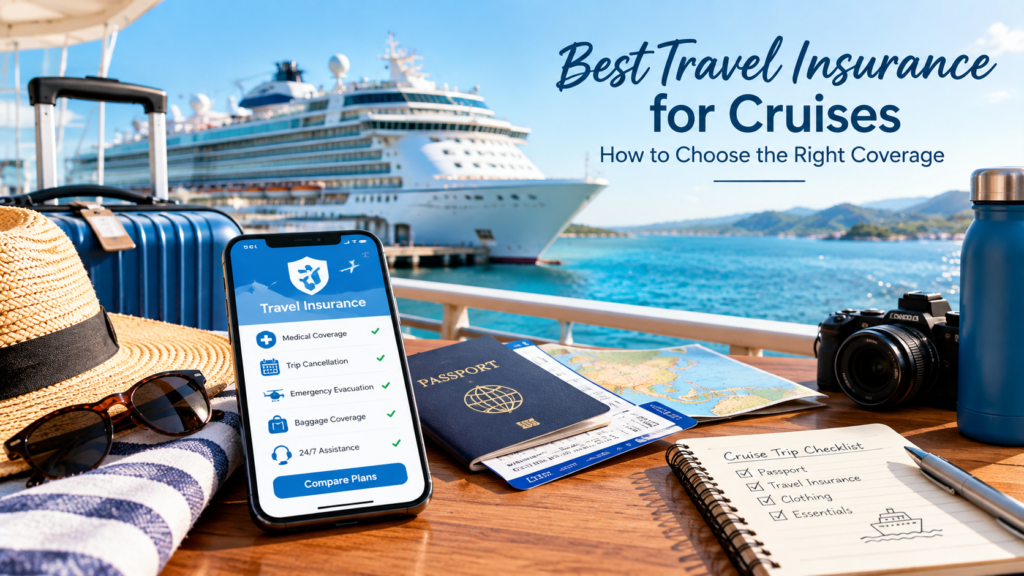

A cruise can feel like one of the easiest ways to travel. Your hotel, transportation between destinations, entertainment, dining, and much of your itinerary are bundled into one trip. But that convenience also creates unique risks. If you miss the ship because of a delayed flight, become seriously ill at sea, lose your luggage, or need emergency transportation from a remote location, ordinary travel arrangements may not be enough to protect you financially.
That is why choosing the best travel insurance for cruises requires a little more thought than simply buying the cheapest policy. Cruise travelers need to consider emergency medical treatment, medical evacuation, trip cancellation, missed connections, itinerary changes, baggage problems, and the cost of flights and hotels surrounding the cruise.

There is no single insurance policy that is perfect for every traveler. A short Caribbean cruise may require different protection from an expensive expedition cruise to Antarctica or a long international sailing. The best option depends on your destination, trip cost, age, health, travel plans, and how much flexibility you want if something goes wrong.
What Makes Cruise Travel Insurance Different
Cruise vacations have several characteristics that make specialized travel protection particularly useful. Unlike a typical city vacation, you may spend several consecutive days at sea, far from a major hospital. Your cruise also operates on a fixed schedule, meaning that arriving late at the port can have serious consequences.
The U.S. Department of State recommends that cruise travelers have medical and emergency evacuation insurance that applies to their trip. It also advises travelers to consider supplemental coverage because regular health insurance or other existing policies may not provide adequate protection overseas.
A comprehensive cruise insurance policy can protect more than the cruise fare itself. Depending on the policy, it may cover flights, hotels, prepaid excursions, baggage, emergency medical treatment, evacuation, travel delays, and other eligible expenses.
The most important point is that coverage varies considerably between policies. A plan advertised as cruise insurance may have very different limits, exclusions, deductibles, and conditions from another plan with a similar price.
Best Travel Insurance for Cruises Compared
Current cruise insurance comparisons highlight several types of policies that can be useful for different travelers. Rather than treating one plan as universally superior, it is more useful to understand where particular options stand out.
Squaremouth’s 2026 cruise insurance comparison currently identifies IMG iTravelInsured Choice as its overall cruise insurance pick, with $100,000 in emergency medical coverage and $500,000 in medical evacuation coverage. Its comparison also identifies Tin Leg Luxury as a budget focused option and Seven Corners Trip Protection Choice as a strong choice for travelers prioritizing medical evacuation protection.
InsureMyTrip’s current cruise comparison also highlights IMG iTravelInsured Choice and Travel Insured International FlexiPAX among its cruise plans, while emphasizing the importance of cruise specific benefits such as missed connections, itinerary changes, and emergency medical evacuation.
These comparisons should be treated as starting points rather than a guarantee that one plan is best for you. Insurance availability, pricing, eligibility, and benefits can change depending on the traveler’s location, age, trip details, and policy purchase date.
IMG iTravelInsured Choice
IMG iTravelInsured Choice is currently one of the stronger all around options for cruise travelers. Squaremouth lists $100,000 in emergency medical coverage and $500,000 in medical evacuation coverage, along with trip cancellation and interruption protection. It can also offer options such as Cancel For Any Reason coverage depending on eligibility.
This type of coverage can be particularly appealing to travelers who want balanced protection rather than concentrating exclusively on one benefit.
Seven Corners Cruise and Trip Protection Options
Seven Corners stands out for travelers who place a high priority on medical evacuation. Current Squaremouth comparisons list up to $1 million in medical evacuation coverage for its Trip Protection Choice plan, making it particularly interesting for cruises visiting remote destinations where reaching appropriate medical care can be more complicated.
Its cruise specific options can also include protection for missed connections and itinerary related disruptions, depending on the selected policy.
Travel Insured International FlexiPAX
FlexiPAX is another option worth examining, particularly for families. Current comparison information lists $100,000 in emergency medical coverage and $500,000 in medical evacuation coverage, along with trip cancellation and interruption benefits. Squaremouth also highlights its family oriented pricing structure, including coverage for children under qualifying conditions.
Families should still read the eligibility rules carefully because benefits and availability can depend on the specific policy and traveler circumstances.
What to Look for in the Best Cruise Insurance
The cheapest travel insurance is not necessarily the best value. When comparing cruise policies, focus first on the benefits that could create the largest financial exposure.
Emergency Medical Coverage
Medical treatment is one of the most important parts of cruise travel insurance. A ship may have an onboard medical facility, but serious situations can require treatment beyond what is available onboard.
Look for a policy with substantial emergency medical coverage and carefully review whether the benefit applies onboard the ship, in foreign ports, and during other parts of your trip.
The U.S. Department of State recommends travelers understand whether their medical insurance works abroad and consider travel medical insurance when existing coverage is insufficient.
Medical Evacuation Coverage
Medical evacuation is especially important on cruises because you can be hundreds of miles from suitable shore based medical facilities.
A strong policy should provide meaningful emergency transportation coverage and clearly explain what constitutes a covered evacuation. Depending on the circumstances, evacuation may involve transportation from the ship to an appropriate medical facility rather than simply returning you home.
The Department of State notes that medical evacuation can be extremely expensive and recommends considering evacuation insurance when traveling to locations where medical care is limited.
Trip Cancellation
Trip cancellation coverage can protect prepaid, nonrefundable expenses when you cannot travel because of a covered reason.
This can include certain unexpected illnesses, injuries, deaths in the family, severe weather events, and other circumstances specified by the policy.
However, cancellation insurance is not the same as being able to cancel for any reason. Standard cancellation coverage generally applies only to listed covered reasons.
Cancel For Any Reason Coverage
Cancel For Any Reason, commonly called CFAR, is an optional upgrade available with some policies.
It can provide greater flexibility if you want to cancel for a reason that is not included in standard trip cancellation coverage. However, CFAR generally comes with additional costs, eligibility requirements, purchase deadlines, and reimbursement limits.
For example, IMG explains that standard trip cancellation can reimburse up to the insured trip cost for covered reasons, while CFAR can reimburse a portion of the trip cost when cancellation occurs for a reason that would otherwise not qualify.
CFAR can be useful for expensive cruises or travelers who want additional flexibility, but it should not automatically be considered essential.
Missed Connection and Missed Departure Coverage
This is one of the most important cruise specific benefits.
Imagine booking a flight that arrives several hours before your cruise departure. A major flight delay causes you to reach the port after the ship has sailed. Without suitable coverage, you could potentially face the cost of transportation to the next port as well as other unexpected expenses.
Some cruise insurance policies provide missed connection benefits that can help with eligible expenses after a covered delay.
Read the policy carefully to understand what delays qualify and what expenses are reimbursable.
Trip Interruption
Trip interruption coverage becomes important after your journey has already started.
If you become seriously ill, suffer an injury, or experience another covered event, interruption coverage may help reimburse eligible prepaid expenses and additional transportation costs.
Some policies offer interruption limits above the original trip cost, but the exact benefit depends on the plan.
Baggage Protection
Lost, stolen, damaged, or delayed luggage can become especially inconvenient on a cruise because you may not have an easy opportunity to replace everything before reaching the next destination.
Look for both baggage loss and baggage delay benefits. Pay attention to per item limits because expensive electronics, jewelry, cameras, and other valuables may have special restrictions.
Cruise Line Insurance vs Third Party Travel Insurance
Many cruise companies offer their own travel protection during the booking process. It can be convenient because it is directly connected to your reservation, but convenience does not automatically mean comprehensive coverage.
Third party travel insurance can give you the ability to compare multiple insurers and select coverage based on your complete journey. It may also provide stronger medical and evacuation limits and can potentially cover flights, hotels, and other prepaid travel arrangements before or after the cruise.
Cruise line protection can still be worthwhile depending on the terms. For example, Royal Caribbean’s current travel protection information includes medical coverage, emergency evacuation, baggage protection, travel delay benefits, and 24 hour assistance.
The best choice therefore comes down to the actual policy wording rather than whether it is sold by a cruise company or an independent insurer.
How Much Does Cruise Travel Insurance Cost?
Cruise insurance commonly costs a percentage of your prepaid, nonrefundable trip expenses. InsureMyTrip currently estimates that cruise insurance typically costs around 4 percent to 10 percent of the prepaid, nonrefundable trip cost, although the final premium varies based on factors such as age, destination, trip duration, coverage, and optional upgrades.
A more expensive cruise does not necessarily mean insurance will cost exactly the same percentage. Your age and selected coverage can significantly affect the final price.
Optional benefits such as CFAR, higher medical limits, or additional protection can also increase the premium.
Instead of choosing a policy based solely on price, compare the total cost against the amount of nonrefundable money you are trying to protect.
When Should You Buy Cruise Travel Insurance?
Buying travel insurance early can be important because some valuable benefits have time sensitive eligibility requirements.
Certain policies may require you to purchase coverage within a specified period after making your initial trip deposit to qualify for benefits such as a preexisting medical condition waiver or CFAR coverage.
InsureMyTrip currently notes that time sensitive benefits often require purchasing insurance within a limited window, commonly around 14 to 21 days after the first trip payment, although requirements vary by policy.
The safest approach is to compare policies shortly after making your cruise deposit rather than waiting until departure is approaching.
What Cruise Travelers Should Check Before Buying
Before purchasing a policy, carefully read the certificate of insurance and policy wording.
Confirm that your cruise destinations are covered and that the policy applies for the full length of your trip. If you are flying to the departure port, include those flights in your insured trip where appropriate.
Check the emergency medical limit, medical evacuation limit, trip cancellation limit, trip interruption limit, baggage benefits, travel delay coverage, and missed connection provisions.
You should also check exclusions. Existing medical conditions, certain activities, alcohol related incidents, travel advisories, pandemics, and other circumstances can be subject to specific restrictions depending on the policy.
If you are planning excursions such as scuba diving, skiing, hiking, or other higher risk activities, verify that the activity is covered before participating.
The U.S. Department of State recommends checking coverage for the countries you will visit, the length of your trip, medical emergencies, transportation, current medical conditions, and planned activities.
Is Cruise Travel Insurance Worth It?
For many travelers, cruise insurance is worth considering because cruises combine several types of financial risk in one vacation.
You may have a nonrefundable cruise booking, flights, hotels, excursions, transportation, and other prepaid expenses. At the same time, you can be traveling through multiple countries and spending extended periods away from shore based medical facilities.
A comprehensive policy can provide protection for both the money invested in the trip and unexpected medical emergencies.
It becomes even more compelling for expensive cruises, international itineraries, remote destinations, older travelers, travelers with significant prepaid expenses, or anyone who would struggle financially with an unexpected evacuation or missed departure.
That does not mean every traveler needs the most expensive policy available. The goal is to identify the risks that would cause the greatest financial damage and purchase suitable protection for those risks.
Pros and Cons of Cruise Travel Insurance
Advantages
Cruise travel insurance can protect prepaid nonrefundable trip expenses against eligible cancellation events. It can also provide emergency medical and evacuation benefits, which are particularly valuable when traveling at sea.
Depending on the policy, travelers can receive protection for missed connections, travel delays, baggage problems, itinerary changes, and trip interruptions.
Third party policies can also allow travelers to compare several insurers rather than accepting a single protection package.
Disadvantages
Travel insurance adds another expense to an already expensive vacation.
Coverage is also subject to exclusions, limits, deductibles, eligibility rules, and documentation requirements. Buying a policy does not mean every cancellation or medical expense will automatically be reimbursed.
CFAR and other optional upgrades can increase the premium substantially.
For these reasons, reading the policy details is just as important as comparing prices.
What to Expect When Making a Claim
If something goes wrong during your cruise, contact the insurer’s assistance service as soon as reasonably possible when the policy requires it.
Keep receipts, medical records, delay confirmations, airline documentation, cruise documents, police reports when applicable, and proof of payment.
Do not assume that verbal approval from a cruise employee automatically means an insurance claim will be accepted. The insurer evaluates claims according to the terms and conditions of the policy.
Having digital copies of your important travel documents can also make the process easier.
Best Travel Insurance for Different Cruise Travelers
The best policy for a budget traveler may not be the best option for a family or an expedition traveler.
For budget conscious travelers, focus on strong medical and cancellation protection without paying for unnecessary upgrades.
For families, compare child coverage, trip cancellation limits, medical benefits, and baggage protection. A family plan with favorable child coverage can sometimes offer significant value.
For senior travelers, pay close attention to age eligibility and preexisting condition provisions. Some policies provide coverage for preexisting conditions only when purchased within a specific time period.
For remote or expedition cruises, prioritize emergency medical evacuation limits. Reaching suitable medical facilities can be considerably more complicated in isolated regions.
For expensive luxury cruises, comprehensive cancellation and interruption coverage becomes particularly important because the amount at risk can be substantial.
Frequently Asked Questions
Do I really need travel insurance for a cruise?
Travel insurance is not always legally required, but it can be valuable because cruises involve significant prepaid expenses, fixed departure schedules, international destinations, and potentially limited medical access at sea. The U.S. Department of State recommends cruise travelers have medical and emergency evacuation coverage.
Is cruise insurance better than regular travel insurance?
Not necessarily. A comprehensive travel insurance policy can be suitable for a cruise if it provides the benefits you need. Cruise specific policies may include additional protection for issues such as missed connections, itinerary changes, and cruise disruptions. Compare the actual benefits rather than relying on the policy name.
Does travel insurance cover missed cruise departures?
Some policies can provide missed connection or missed departure benefits when the cause is covered. However, the reason for the delay, required documentation, time limits, and reimbursement amount depend on the policy.
Does travel insurance cover medical emergencies on a cruise ship?
Some comprehensive travel insurance policies provide emergency medical coverage for covered illness or injury during a cruise. However, you should verify the policy wording regarding onboard treatment, foreign ports, exclusions, deductibles, and coordination with other insurance.
Does travel insurance cover medical evacuation from a cruise ship?
Many comprehensive policies include emergency medical evacuation, but the amount and conditions vary. This is one of the most important benefits to compare because evacuation from a ship can involve significant transportation costs.
Is Cancel For Any Reason insurance worth it for a cruise?
CFAR can be worthwhile when you want more flexibility than standard cancellation coverage provides. However, it generally costs more and may reimburse only a percentage of the insured trip cost. Eligibility and purchase deadlines also apply, so compare the actual terms before buying.
Can I buy cruise travel insurance after booking?
Yes, travel insurance can generally be purchased after booking, but waiting may cause you to miss certain time sensitive benefits. Some preexisting condition waivers and CFAR options have strict purchase windows.
Should I buy cruise insurance from the cruise line?
Cruise line insurance can be convenient and may provide useful protection. However, third party policies can offer more choices and may provide broader protection for the entire trip. Compare medical limits, evacuation coverage, cancellation benefits, baggage protection, and exclusions before deciding.
Final Recommendation
The best travel insurance for cruises is not necessarily the cheapest policy or the one with the longest list of benefits. The strongest choice is the policy that protects the risks most likely to create a serious financial problem during your particular journey. For most cruise travelers, that means paying close attention to emergency medical coverage, medical evacuation, trip cancellation, trip interruption, missed connections, baggage protection, and cruise specific disruptions.
Current 2026 comparison data makes IMG iTravelInsured Choice a strong all around option to investigate, while Seven Corners can be particularly attractive for travelers who prioritize high medical evacuation limits. Travel Insured International FlexiPAX is also worth comparing for families. These are comparison starting points rather than universal recommendations, and travelers should confirm current pricing, availability, eligibility, exclusions, and policy wording before purchasing.
For an expensive international cruise, buying comprehensive protection early is generally a sensible approach. Compare several policies, include your flights and other prepaid arrangements where appropriate, check the countries on your itinerary, and make sure the medical and evacuation limits are appropriate for your destination. Most importantly, read the policy before you buy it. A few minutes spent comparing coverage can make a major difference if your cruise does not go according to plan.