
Introduction
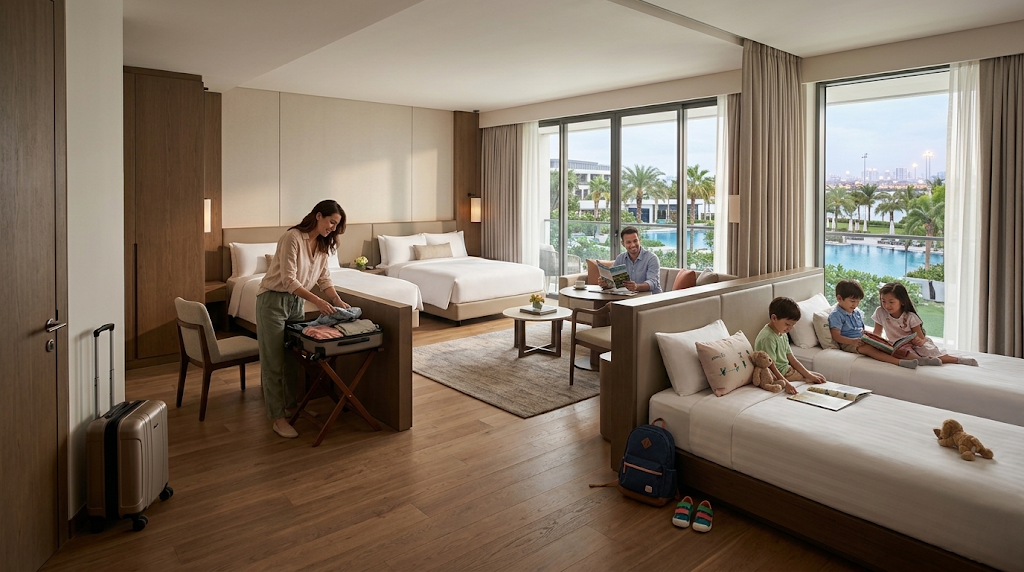
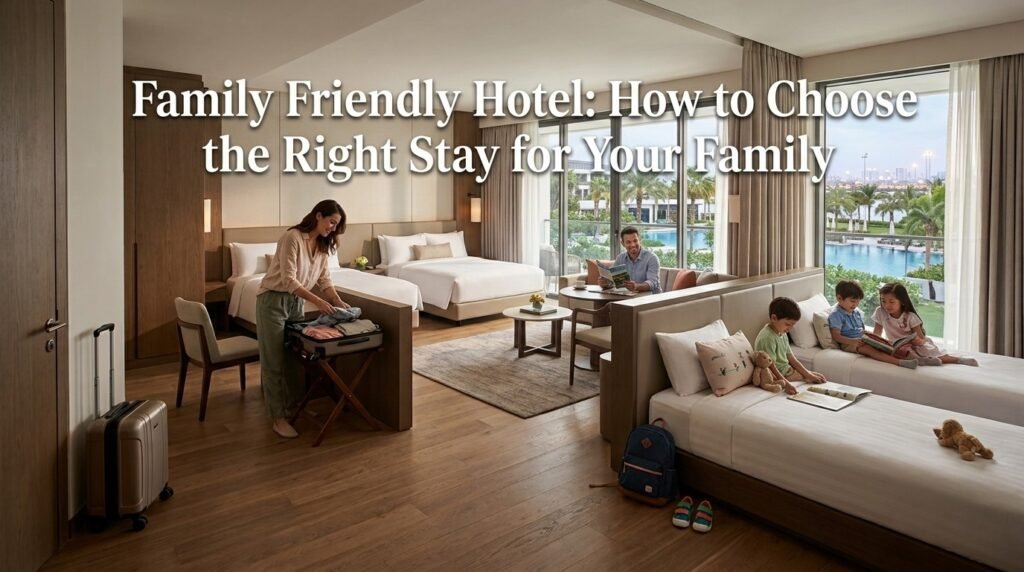
Choosing a family friendly hotel is about much more than finding a property that allows children. A hotel can have a swimming pool, colorful photographs, and a children’s menu while still being inconvenient for parents traveling with young children. The room layout, sleeping arrangements, location, dining options, noise levels, transportation, and everyday facilities can have a much greater effect on the quality of a family holiday.
The right hotel should make ordinary parts of the trip easier. Parents should be able to get everyone ready in the morning, store snacks or milk, return to the room without a complicated journey, and settle children comfortably at night. Older children and teenagers may need their own space and activities, while families with babies may care more about a quiet room, a crib, a refrigerator, and easy access to food.
This guide explains what to look for before booking, how different family accommodation options compare, which hotel features are genuinely useful, and the questions worth asking before you pay for a room.
What Makes a Hotel Truly Family Friendly
A genuinely family friendly hotel is one where the rooms, facilities, policies, and location support the practical realities of traveling with children. The label itself is not enough. Families should examine what the property actually provides.
Room configuration is one of the strongest indicators. A hotel may advertise a room for four people, but that does not necessarily mean four comfortable beds or separate sleeping areas. A family of four may be expected to share two beds, use a sofa bed, or sleep in one open space. That arrangement may work for a short city break but become tiring during a longer holiday.
Connecting rooms can be especially useful because parents can maintain some privacy while keeping children nearby. It is important to distinguish connecting rooms from adjoining rooms. Connecting rooms normally have an internal door between the rooms, while adjoining rooms may simply be located next to one another. Families who need a connecting door should confirm the arrangement directly with the hotel rather than assuming a request will be guaranteed.
Family friendly versus simply allowing children
A hotel does not necessarily become family friendly simply because children are permitted to stay there. A practical family hotel considers things such as sleeping arrangements, child appropriate facilities, food, transportation, and the needs of parents.
A small refrigerator can be surprisingly valuable for families with babies or young children. Parents may need somewhere to keep milk, snacks, fruit, or drinks. A bathtub may also be more practical than a shower for families traveling with very young children.
The best approach is to think about what your family will actually need during an ordinary day rather than focusing only on attractive hotel photographs.
The practical needs of different age groups
Babies and toddlers generally require more practical support. A crib, refrigerator, quiet room, suitable bathroom, elevator access, and convenient food options may be more important than entertainment.
Children in the early school years often benefit from swimming pools, playgrounds, family activities, flexible dining, and outdoor space.
Older children and teenagers may care more about Wi Fi, sports facilities, organized activities, larger rooms, and having some independence.
This is why there is no single definition of the perfect family hotel. The best choice depends on the ages of the children and the purpose of the trip.
Choose the Right Room Before Choosing the Hotel
Families often spend considerable time comparing hotels but surprisingly little time examining the exact room they will receive. That can create problems after arrival.
The room should be treated as a major part of the travel decision rather than simply a place to sleep.
Family rooms and suites
A family room may provide additional beds, bunk beds, a sofa bed, or a larger open space. A suite may provide a separate living area, although the exact layout varies considerably between properties.
Before booking, check the actual bed configuration, maximum occupancy, bathroom arrangement, and whether children will have a separate sleeping area.
A larger room is not automatically better. A smaller room with a useful layout can sometimes work better than a spacious room where everyone sleeps in the same open area.
For families with young children who go to bed early, a separate sleeping area can be particularly valuable. Parents may want to read, talk, work, or relax without disturbing sleeping children.
Connecting and adjoining rooms
Connecting rooms are particularly useful for families with older children or teenagers. They provide greater privacy while keeping the family close together.
However, connecting rooms can have limited availability. If this arrangement is essential, contact the hotel before finalizing the reservation and confirm exactly what has been reserved.
Do not rely only on a booking website phrase such as adjoining rooms or rooms close together. Those terms may not provide the internal connection a family actually needs.
Cribs, sofa beds, and sleeping arrangements
Never assume that a crib, rollaway bed, or sofa bed is automatically available. Some hotels provide these items only on request, and availability can be limited.
Ask whether the extra sleeping arrangement is included, whether there is an additional charge, and whether the room still complies with occupancy limits.
For babies, parents should also consider whether the bathroom has a bathtub, whether there is enough space for a crib, and whether furniture placement allows the room to remain practical.
Location Matters More Than Many Families Expect
A hotel can be excellent on paper and still be a poor choice if its location makes every daily activity difficult.
Families should consider how much time they will spend getting to attractions, restaurants, supermarkets, beaches, parks, and transportation.
Hotels near attractions
A centrally located hotel can reduce transportation time during a sightseeing holiday. This can be particularly useful when traveling with toddlers who need regular breaks.
Being close to attractions also makes it easier to return to the room for naps or quiet time.
However, central locations can sometimes mean more street noise, nightlife, traffic, and crowds. Parents should therefore consider the balance between convenience and sleep.
City hotels and public transportation
For a city trip, access to public transportation may be more valuable than having numerous hotel facilities.
A family that plans to visit museums, parks, historic sites, shopping areas, and restaurants may benefit from staying near a reliable transit connection. A hotel requiring taxis for every journey can become expensive and tiring.
Families using strollers should also investigate elevator access and whether the surrounding streets are practical for walking.
Resort locations and convenience
At a beach or resort destination, staying farther from restaurants and attractions may not be a problem if most activities are available on site.
A resort with dining, swimming facilities, children’s activities, and comfortable outdoor areas can allow families to spend several days without arranging transportation.
The important question is whether the hotel matches the purpose of the trip. A resort can be ideal for relaxation but less suitable for a family planning extensive sightseeing.
Family Facilities Worth Looking For
Hotel facilities can make a family vacation considerably easier, but families should evaluate them based on usefulness rather than quantity.
Pools and water facilities
A swimming pool is one of the most attractive features for children, but parents should look beyond the photograph.
Check whether there is a separate children’s pool, whether the pool has shallow areas, whether supervision is provided, and whether there are specific rules for young children.
Pool access should never replace appropriate parental supervision.
A beautiful main pool may be less useful for a toddler than a smaller shallow area designed for young children.
Kids clubs and activities
A children’s club can give parents valuable time to relax while children participate in supervised activities. However, families should verify the age range, operating hours, reservation requirements, staffing arrangements, and whether additional charges apply.
A hotel may advertise a kids club without it being suitable for every age group.
Families should also consider whether activities match their children’s interests. A teenager may have little interest in a program designed for preschool children.
Outdoor and indoor spaces
Playgrounds, gardens, recreation rooms, game areas, and shaded outdoor spaces can be useful when children need a break from sightseeing.
These facilities can be particularly valuable during longer stays because families do not have to leave the property every time children want something to do.
Laundry and practical amenities
Laundry facilities are easy to overlook until a child spills food or drinks on several outfits.
For longer family trips, access to laundry can reduce the amount of clothing parents need to pack.
Other useful features may include luggage storage, a refrigerator, microwave access, high chairs, baby equipment, and convenient parking.
The value of these amenities depends heavily on the family and destination.
Food and Dining for Families
Food can become one of the biggest daily challenges when traveling with children.
A hotel does not need an elaborate children’s restaurant to work well for families. What matters is whether parents can obtain suitable food at convenient times.
Breakfast
Breakfast can save time during a busy travel day, particularly when families need to leave the hotel early.
Before booking, check whether breakfast is included, what type of breakfast is served, and whether the schedule fits your plans.
A family that needs to leave early for an airport transfer or sightseeing tour may find a flexible breakfast arrangement more useful than an extensive buffet that opens late.
Refrigerators and kitchen facilities
A refrigerator can be important for families with babies, toddlers, or children with specific food requirements.
A kitchenette or apartment style accommodation can provide even more flexibility for longer stays.
However, families should confirm exactly what the room contains. A minibar is not always the same thing as a usable refrigerator, and photographs may not clearly show the available facilities.
Nearby restaurants and grocery options
Even when a hotel has an excellent restaurant, nearby food options can provide valuable flexibility.
Parents may want a quick meal rather than a formal dinner after a long day. A grocery store or convenience shop nearby can also be useful for drinks, snacks, breakfast supplies, and baby essentials.
This is one reason location should be evaluated together with hotel facilities.
Safety and Accessibility
Safety deserves more attention than decorative features when selecting accommodation for children.
Parents should consider balconies, staircases, pool access, room location, windows, bathroom design, and general property layout according to the age of their children.
Families traveling with a stroller should check whether there is step free access from the entrance to the room. An elevator may exist inside the hotel but still fail to provide convenient access from the street.
Families with mobility requirements should ask specific questions about accessible rooms, bathrooms, entrances, elevators, and public areas instead of relying on a general accessibility label.
Accessibility should be confirmed directly with the property when particular features are essential.
How to Compare Family Friendly Hotels
The easiest way to compare hotels is to create a shortlist based on the things your family actually needs.
| Factor | What to Check | Why It Matters |
|---|---|---|
| Room | Beds, occupancy, separate sleeping areas | Determines comfort and sleep |
| Location | Attractions, transport, restaurants | Reduces daily travel time |
| Food | Breakfast, restaurants, refrigerator | Makes family meals easier |
| Pool | Shallow area, rules, supervision | Helps families use facilities safely |
| Activities | Kids club, games, outdoor space | Keeps children occupied |
| Accessibility | Elevators, entrances, bathrooms | Important for strollers and mobility needs |
| Cost | Room, breakfast, parking, extras | Shows the real trip budget |
| Policies | Cancellation and extra bed rules | Reduces booking surprises |
The most expensive hotel is not necessarily the best family option. A moderately priced hotel with a practical room, excellent location, breakfast, and useful facilities may provide better value than a luxury property that requires additional transportation and expensive meals.
Family Hotels Versus Vacation Rentals
Families should also consider whether a hotel is the right type of accommodation.
A vacation rental may be more suitable for a family that needs multiple bedrooms, a full kitchen, laundry facilities, or a longer stay.
A hotel can be more convenient when parents value daily housekeeping, luggage storage, front desk assistance, room service, and a more predictable arrival process.
For a short city break, a hotel near public transportation may be easier than a large rental located far from the center.
For a longer holiday, having a kitchen and laundry facilities can become more valuable.
Neither option is automatically superior. The right choice depends on how your family spends its time.
Booking Tips That Can Prevent Problems
Before making a reservation, verify the details that could affect your stay.
Confirm the exact sleeping arrangement rather than relying on the phrase family room.
Ask whether connecting rooms are guaranteed or simply requested.
Check whether a crib, rollaway bed, or high chair must be reserved.
Look at the hotel’s cancellation and modification policy.
Calculate additional charges for breakfast, parking, extra guests, and other services.
Check the hotel’s location against the places you actually plan to visit.
Ask about pool access and children’s facilities if these are important to your trip.
If your family has accessibility requirements, communicate those needs directly with the property.
Travelers should also check official hotel information close to the travel date because facilities, policies, and services can change.
Common Mistakes Families Make
One common mistake is choosing a hotel based almost entirely on photographs. Beautiful pools and stylish rooms can be appealing, but they do not tell you whether the sleeping arrangement works for your family.
Another mistake is assuming that a room advertised for a certain number of guests will automatically provide comfortable beds for everyone.
Families can also underestimate the importance of location. A hotel that looks inexpensive may become more expensive once daily transportation and restaurant costs are added.
Another problem is failing to consider children’s bedtime. An open plan room may look spacious but can become uncomfortable when parents want to stay awake after children have gone to sleep.
Finally, families sometimes book facilities without checking their actual conditions. A children’s club may have age restrictions, while a pool may have seasonal operating schedules or specific rules.
Who Benefits Most From a Family Friendly Hotel
A family friendly hotel is particularly useful for parents who want accommodation that reduces the logistical challenges of traveling with children.
Families with babies may value cribs, refrigerators, quiet rooms, elevators, and nearby food.
Families with young children may prioritize pools, playgrounds, children’s meals, and convenient locations.
Families with older children may prefer connecting rooms, larger accommodations, entertainment, sports facilities, and reliable internet access.
Families traveling with teenagers may benefit from properties that provide enough independence without separating family members too far apart.
The best hotel is therefore the one that fits the family’s daily routine rather than the one with the longest amenities list.
Frequently Asked Questions
What makes a hotel family friendly?
A family friendly hotel provides practical accommodation and facilities that make traveling with children easier. Important considerations include suitable sleeping arrangements, convenient location, family dining, child appropriate facilities, accessibility, and clear policies for cribs or extra beds.
What type of hotel room is best for a family?
The best room depends on the number and ages of children. Families with young children may prefer a suite or room with a separate sleeping area, while families with older children may benefit from connecting rooms. Always confirm the exact layout and bedding before booking.
Are connecting rooms better than a family room?
Connecting rooms can provide more privacy and separate sleeping areas, which can be especially useful for families with older children. A family room may be simpler and more affordable for families comfortable sharing one space. The better choice depends on age, budget, and sleeping habits.
What should families look for in a hotel pool?
Parents should check whether the hotel has a children’s pool or shallow area, pool access rules, supervision arrangements, and any age or safety requirements. Children should always be supervised appropriately regardless of hotel facilities.
Is breakfast important in a family hotel?
Breakfast can be very useful because it reduces the need to find food early each morning. Families should consider the breakfast schedule, price, food choices, and whether the timing fits their sightseeing or transportation plans.
Are family hotels more expensive?
Not necessarily. Family friendly features can exist across different price categories. The important comparison is the total cost of the stay, including room configuration, meals, transportation, parking, and additional services.
Should families choose a hotel near attractions?
Often, yes, particularly for city trips with young children. Being close to attractions can reduce transportation time and make it easier to return for naps or breaks. However, families should also consider noise and the overall environment around the hotel.
Is a vacation rental better than a family hotel?
A vacation rental may be better for families that need several bedrooms, a kitchen, or laundry facilities. A hotel may be more convenient for shorter stays and families that value housekeeping, front desk support, luggage storage, and on site services.
Conclusion
Choosing a family friendly hotel is ultimately about making the everyday parts of travel easier. The most useful properties provide practical sleeping arrangements, suitable facilities, convenient food options, accessible transportation, and a location that matches the family’s itinerary. Features such as connecting rooms, refrigerators, children’s pools, laundry, and flexible dining can often matter more than impressive decoration.
The right accommodation also depends on the age of the children and the purpose of the trip. Parents traveling with babies may prioritize quiet rooms and practical equipment, while families with school age children may want pools and activities. Families with teenagers may prefer connecting rooms and greater independence. No single hotel setup works equally well for every family.
Before booking, look beyond the family friendly label and examine the actual room, location, facilities, policies, and total cost. Confirm anything essential directly with the hotel, especially connecting rooms, cribs, accessibility features, and special sleeping arrangements. When those details fit your family’s needs, the hotel becomes more than somewhere to sleep. It becomes a practical base that allows everyone to enjoy the trip with less unnecessary stress.