
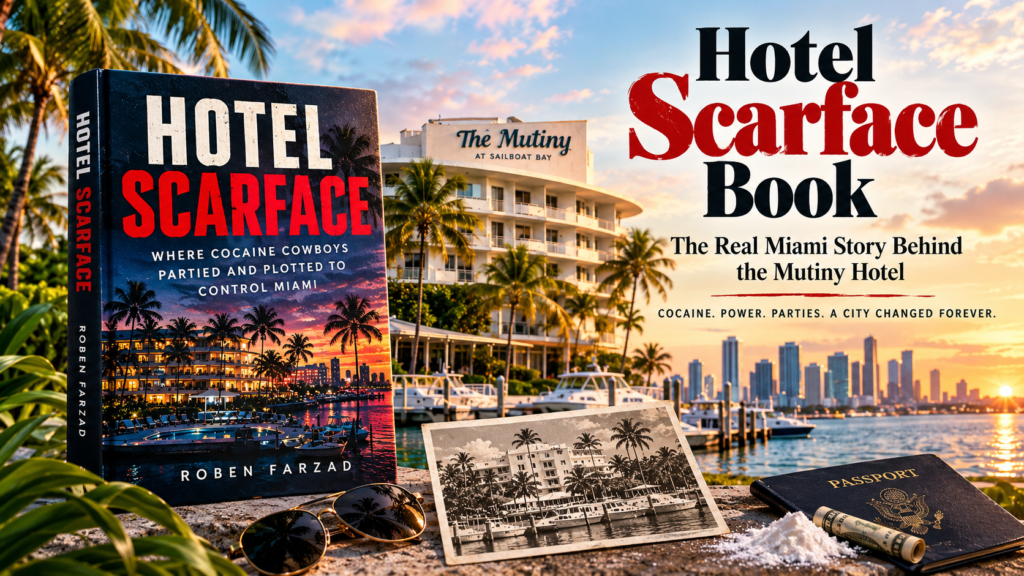

What Is the Hotel Scarface Book About?
If you searched for scarface hotel book, you are probably looking for Hotel Scarface: Where Cocaine Cowboys Partied and Plotted to Control Miami by journalist Roben Farzad.
Published in 2017, the book examines the rise and fall of Miami’s cocaine economy through the story of the Mutiny at Sailboat Bay, a hotel and nightclub in Coconut Grove. Penguin Random House describes it as an investigative account based on interviews and previously unseen documents, focusing on the hotel’s role in Miami’s cocaine fueled era.
The title can be slightly confusing because Hotel Scarface was not the hotel’s actual name. The real property was known as the Mutiny at Sailboat Bay, commonly called the Mutiny Hotel. The nickname “Hotel Scarface” connects the real life history of the Mutiny with the larger mythology surrounding Miami and the 1983 film Scarface.
Farzad’s book is therefore not a novelization of the movie and is not simply a behind the scenes account of the film. It is nonfiction history and investigative storytelling about a real Miami hotel, the people who gathered there, and the cocaine trade that transformed South Florida.
The Real Hotel Behind Hotel Scarface
The heart of the book is the Mutiny at Sailboat Bay in Coconut Grove.
The property opened in 1969 and became particularly notorious during Miami’s cocaine boom of the late 1970s and early 1980s. Contemporary reporting and later accounts describe the Mutiny as a place where wealthy socialites, celebrities, businessmen, criminals, law enforcement figures, and drug traffickers could cross paths.
That mixture is an important reason the location became so significant. It was not simply a hotel where criminals happened to stay. During its most notorious period, the hotel and its private club functioned as a social meeting point within a much larger network involving Miami nightlife, organized crime, international drug trafficking, money, politics, and law enforcement.
The Mutiny reportedly had around 130 rooms and became famous for its exclusive club and extravagant atmosphere. The setting helped create a strange contrast: behind the tropical glamour of Coconut Grove was a world increasingly affected by violence, corruption, and the enormous profits generated by cocaine trafficking.
That contrast is central to the story Farzad tells.
Who Wrote Hotel Scarface?
Roben Farzad is a journalist and broadcaster who grew up in Miami and developed an interest in the Mutiny’s history long before writing the book.
According to reporting about the book, Farzad first became fascinated with the abandoned property as a teenager in the 1990s. That curiosity eventually developed into years of research, interviews, and investigation.
Farzad’s professional background is important because Hotel Scarface reads more like investigative history than a conventional crime novel. Penguin Random House identifies him as the host of Full Disclosure and a contributor to NPR and PBS NewsHour, with previous experience covering business, international affairs, and Latin America.
The result is a book that tries to place the Mutiny within the wider development of Miami rather than treating the hotel as an isolated curiosity.
Miami During the Cocaine Boom
To understand Hotel Scarface, it helps to understand the Miami surrounding the Mutiny.
During the late 1970s and early 1980s, Miami was undergoing enormous social and economic changes. Cocaine trafficking generated vast amounts of illegal money, while immigration, political tensions, nightlife, real estate development, and violent crime were reshaping the city.
The period is often remembered through popular culture. Television series such as Miami Vice and movies such as Scarface created enduring images of pastel colored Miami, fast cars, nightclubs, cocaine, guns, and extravagant lifestyles.
But Farzad’s book focuses on the historical reality underneath those images.
Kirkus describes the Mutiny as an important center of Miami’s cocaine boom and notes that the book follows the violence, arrests, turf conflicts, and eventual decline surrounding the cocaine economy.
This makes the book particularly interesting for readers who want to separate the Hollywood version of 1980s Miami from the documented history.
Why Did the Mutiny Hotel Become So Famous?
The Mutiny became famous because it offered something that many other places could not privacy, exclusivity, luxury, nightlife, and access to influential people.
Its private club attracted a remarkable mixture of guests. Farzad’s research includes accounts involving drug traffickers, celebrities, law enforcement figures, businessmen, political figures, and people connected to intelligence and international smuggling networks.
The hotel became particularly associated with extravagant spending.
Contemporary and retrospective accounts describe expensive champagne, elaborate suites, private parties, and large amounts of cash circulating through the property. The club’s exclusivity also gave it a reputation as a place where people wanted to be seen.
That is where the story becomes more complicated.
The luxury was not separate from the criminal economy. The money generated through cocaine trafficking helped finance the lifestyle, while the hotel’s social environment allowed people from very different worlds to meet.
In that sense, the Mutiny became a symbol of Miami during the period glamorous on the surface, unstable underneath.
Hotel Scarface and the Movie Scarface
One of the biggest reasons people search for the scarface hotel book is the connection to the famous 1983 film Scarface.
The connection is real, but it needs to be explained carefully.
The Mutiny was not the same place as the fictional Babylon Club in the movie. Instead, the real hotel helped influence the atmosphere and cultural mythology surrounding Miami’s cocaine era.
According to Miami New Times, Scarface filmmakers Oliver Stone and Brian De Palma stayed at the Mutiny and sought permission to film there. Members of the film’s cast also stayed at the hotel.
The relationship between the movie and the hotel is therefore one of influence and historical context rather than simple location identification.
The film dramatized the world of Tony Montana. Hotel Scarface, by contrast, investigates the real people and events behind the Miami cocaine era.
That distinction is worth remembering before reading the book.
What to Expect From the Hotel Scarface Book
Readers should not approach Hotel Scarface expecting a traditional travel guide or a fictional thriller.
It is nonfiction, and the narrative contains a large cast of real people and interconnected events.
Penguin Random House lists the paperback at 368 pages in its U.S. edition, while different editions have different page counts. The original book was published in October 2017.
The story combines:
- Miami history
- True crime
- Organized crime
- Drug trafficking
- Immigration history
- Politics and law enforcement
- Nightlife and popular culture
- The rise and decline of the Mutiny
- The development of modern Miami
One potential challenge is the number of characters.
Miami New Times noted that the book contains a large cast and uses 55 relatively short chapters, giving the story a fast moving, almost episodic structure.
For readers unfamiliar with the history, keeping track of names and relationships may take some effort.
For readers who enjoy investigative nonfiction, however, that complexity is part of the appeal.
The People Behind the Story
One of the strongest elements of Hotel Scarface is that it does not reduce the history to one fictionalized crime boss.
The book explores a network of individuals who participated in or were affected by Miami’s cocaine economy.
Among the figures discussed in coverage of the book are Willie Falcon and Sal Magluta, known as “Los Muchachos,” as well as other traffickers, informants, law enforcement officers, and people associated with the Mutiny.
This approach gives the story a broader perspective.
The cocaine economy was not simply about criminals making money. It involved banks, businesses, transportation, immigration, policing, politics, nightlife, real estate, and communities.
That is one reason the book is useful as a piece of Miami history rather than simply a true crime story.
The Darker Side of the Miami Story
The glamour surrounding the Mutiny can make the era sound almost entertaining from a distance.
The book makes clear why that interpretation is incomplete.
The same period involved addiction, murders, corruption, intimidation, arrests, and long lasting damage to individuals and communities. Kirkus emphasizes the contrast between the wealth and glamour surrounding the cocaine trade and its violent consequences.
This is important for anyone approaching the book through Scarface or Miami Vice.
Popular culture often turns the era into an aesthetic neon lights, sports cars, expensive clothes, nightclubs, and tropical scenery.
Hotel Scarface provides the historical context behind that image.
The real story was considerably more complicated.
Hotel Scarface as a Miami Travel History Reference
Although Hotel Scarface is not a travel guide, it can be particularly interesting for travelers who enjoy understanding the history behind a destination.
Miami is often presented through beaches, Art Deco buildings, nightlife, restaurants, shopping, and luxury hotels. Those are important parts of the city, but they represent only one layer of Miami’s history.
Reading about the Mutiny can provide another perspective on Coconut Grove and the wider Miami area.
The book is especially relevant if your trip includes:
- Coconut Grove
- Downtown Miami
- South Beach
- Miami’s historic neighborhoods
- Miami film locations
- Miami crime history
- Cuban American history
- 1970s and 1980s Miami culture
It works best as background reading before exploring the city rather than as a guidebook for attractions.
Can You Visit the Former Mutiny Hotel?
This is where travelers should be careful with expectations.
The historic Mutiny property is associated with 2951 S. Bayshore Drive in Coconut Grove. Miami New Times reported that after years of decline, the property reopened in 1999 as an upscale condominium hotel.
That means visitors should not expect to arrive at a preserved 1970s crime era hotel attraction.
The property has changed substantially from the environment described in Farzad’s book.
There is also no official “Hotel Scarface” tourist attraction corresponding to the book’s title. The name is primarily a reference to the hotel’s infamous historical reputation.
If you visit Coconut Grove because of the book, the value is therefore largely historical. You are seeing part of modern Miami while knowing what once occupied the same setting.
What to Explore Around the Story
A Hotel Scarface themed Miami trip can be combined with broader cultural sightseeing.
Coconut Grove
Coconut Grove offers a very different atmosphere from the Miami portrayed in old crime movies. It is one of the city’s established neighborhoods and provides useful context for understanding how dramatically Miami has changed.
South Beach
South Beach is particularly relevant to fans of Scarface because Miami Beach has several documented filming locations associated with the movie.
The City of Miami Beach identifies 728 Ocean Drive as the location of the famous “chainsaw scene” from Scarface.
This is separate from the Mutiny Hotel, but combining the two gives movie fans a way to explore both the fictional and real world sides of Miami’s crime era mythology.
Miami’s Historical Neighborhoods
Travelers interested in the period should also consider Miami’s Cuban American history, immigration history, architecture, and museums rather than focusing only on crime stories.
That broader context makes the story more meaningful and avoids reducing Miami’s history to the cocaine trade alone.
Pros and Cons of Hotel Scarface
What works well
The book’s biggest strength is research.
Penguin Random House says Farzad based the book on interviews and previously unseen documents, while Miami New Times described the work as extensively researched with numerous interviews.
The writing also benefits from a strong sense of place. Farzad grew up in Miami, and his interest in the Mutiny developed over many years.
The short chapters can also make a complicated historical story easier to follow.
What may not work for every reader
The large number of characters can become difficult to track.
The book also deals with disturbing subjects, including violence, drug trafficking, murder, and addiction. Readers looking for a light Miami history book may find its subject matter intense.
Some readers may also prefer a more traditional academic history, while Hotel Scarface uses a narrative investigative style.
Is Hotel Scarface Worth Reading?
Whether Hotel Scarface is worth reading depends largely on what you want from the book.
If you are interested in Miami history, true crime, organized crime, the cocaine trade, immigration, or the real world background behind movies such as Scarface, the book offers substantial material.
It is particularly useful for readers who want to understand how the mythology of 1980s Miami developed. Reviews from Kirkus and Miami New Times emphasize the book’s historical research and its focus on the Mutiny’s central role in the city’s cocaine era.
It may be less suitable if you are looking for a conventional travel book about Miami’s beaches, restaurants, hotels, and attractions.
For travelers, the book works best as historical background reading. It can add depth to a Miami itinerary, especially if you are interested in the city’s transformation during the late twentieth century.
Hotel Scarface vs Scarface the Movie
The two are connected, but they are fundamentally different.
| Hotel Scarface | Scarface |
|---|---|
| Nonfiction book | Fictional crime film |
| Written by Roben Farzad | Directed by Brian De Palma |
| Focuses on real Miami history | Follows fictional Tony Montana |
| Centers on the Mutiny | Centers on Montana’s criminal empire |
| Investigative and historical | Dramatic and cinematic |
| Based on research and interviews | Screenplay by Oliver Stone |
| Explores a wider network of people | Focuses primarily on fictional characters |
The distinction is important because searching for the scarface hotel book can easily lead readers to confuse the real Mutiny with the fictional world of the movie.
The book provides the historical framework; the film provides a highly dramatized interpretation of the era.
Frequently Asked Questions
What is the Hotel Scarface book about?
Hotel Scarface: Where Cocaine Cowboys Partied and Plotted to Control Miami is Roben Farzad’s nonfiction account of Miami’s cocaine era, centered on the real Mutiny at Sailboat Bay hotel and nightclub in Coconut Grove.
Is Hotel Scarface a true story?
Yes. It is nonfiction history and investigative journalism based on interviews, research, and documents concerning real people and events.
Was the real Scarface hotel in Miami?
The name “Hotel Scarface” refers to the real Mutiny at Sailboat Bay in Coconut Grove. “Hotel Scarface” was not the property’s official historical name.
Is the Mutiny Hotel still the same hotel?
No. The property has undergone major changes since its notorious period. Miami New Times reported that it reopened in 1999 as an upscale condo hotel after years of decline.
Is Hotel Scarface connected to the movie Scarface?
Yes, historically and culturally. The Mutiny helped inform the real world Miami atmosphere associated with the movie, and reporting says members of the film’s production stayed at the hotel. However, the book is not a novelization of the film.
Who wrote Hotel Scarface?
The book was written by journalist Roben Farzad and published in 2017.
Is Hotel Scarface a travel guide?
No. It is primarily a nonfiction history and true crime book. Travelers can use it as background reading to understand an important chapter of Miami history.
Where was the Mutiny Hotel?
The historic property was located at 2951 S. Bayshore Drive in Coconut Grove, Miami.
Conclusion
Hotel Scarface is much more than a book about a notorious Miami hotel. Roben Farzad uses the story of the Mutiny at Sailboat Bay to examine a turbulent period when cocaine money, nightlife, immigration, organized crime, law enforcement, and rapid economic change collided in South Florida. The book’s real subject is the transformation of Miami and the people caught up in it.
For travelers, the book is especially valuable when paired with a visit to Miami. The former Mutiny property is no longer the legendary nightlife destination described in accounts of the cocaine era, but knowing its history can change how you view Coconut Grove and the wider city. Fans of Scarface can also combine the historical story with documented movie locations around Miami Beach.
If your interest in scarface hotel book comes from curiosity about the real story behind Miami’s famous crime era image, Hotel Scarface is a useful place to start. It should not be read as a glamorous account of the cocaine trade, but as an investigation into how wealth, crime, violence, and social change shaped one of America’s most recognizable cities. For readers interested in Miami history, true crime, or the reality behind the Scarface mythology, it offers considerably more context than the movie alone.



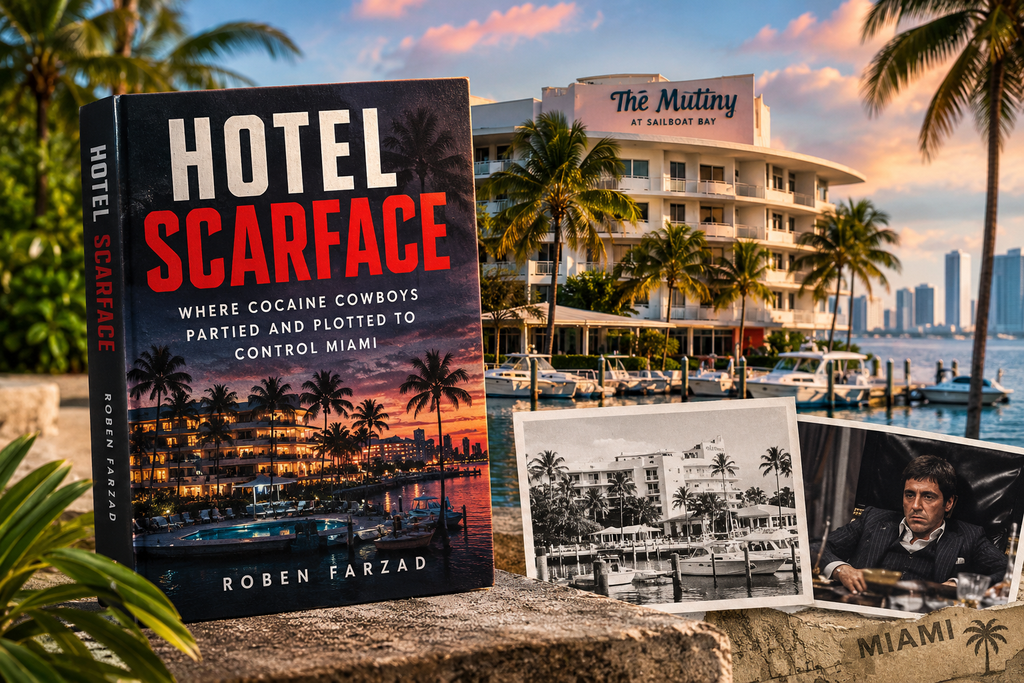
This image captures the atmosphere behind “Hotel Scarface” a fascinating look at the real history of Miami’s Mutiny Hotel and the city’s turbulent cocaine era. The combination of the historic hotel, Miami waterfront, and the book itself reflects how glamour, nightlife, crime, and changing city culture became closely connected during this period. For anyone interested in Miami history, true crime, or the real world story behind the “Scarface” mythology, this book offers an intriguing perspective beyond what Hollywood showed on screen.